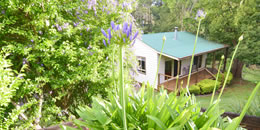
Montville, Queensland, Australia.
It is not apparent that any Aboriginal tribes lived on the Blackall Range, but certainly members of the Kabi tribe gathered every two or three years on the banks of the Obi Obi Creek at Baroon Pocket to feast on the fruit of the Bunya Pine (Bonyi Bonyi). It was a place of enrichment and celebration; a place to exchange songs, stories, tools and ornaments, for marriages to be arranged, and conflicts resolved. The lagoon in Russell Family Park to the west of the Montville shops was a watering hole on the way to Baroon. An old track came up from the coast, opposite where "Penefathings Inn" is now.
Timber getters knew of the rich timber resources from before the Separation of Queensland in 1859 but it is not until the eighteen-eighties that land selections were permitted to E.J.Burnett and G.L.Bury. The first true settlers were T.P.L.Weitemeyer and his family, who took up residence in 1887 on what is now Mill Hill Road. Remingtons, Butts, Burnetts, Smiths, Muirheads, Mills, Skenes, Vinings, Harveys, Daltons, Burys and others joined them at this time.
The first task of the settlers was to clear some land for their sustenance and living. The clearing was in itself the industry of timber getting, and "shutes" such as Remington's were used to slide the huge logs down the mountain to bullock wagons or creeks, to take the timber to mills on the coast. Farming followed old European patterns for a time, and dairying was a staple industry, but soon the subtropical climate fostered the farming of citrus, pineapples, macadamias and avocados.
In the 1890's, Henry Smith and his brother Alfred selected land on the Back Road (Western Road) and acquired more along the Main Road. Henry was a man of business. He built the first cattle dip, opened the first store and Post Office, had a store in Palmwoods by the railhead, and ran the first private telephone line between the shop and his Montville home. That house still exists, a beautifully preserved private home called "Belbury" looking down on the park. Henry proposed the name for the settlement, calling it after a district in Connecticut USA where he had lived with his parents who emigrated there from England. Alfred built a shop on Main Road, which grew up, to become known now as "Misty's".
The road to the coast was a rough track down the Razorback ridge, it was not until 1929 that the "Palmwoods Road" was completed. The sports ground was also opened in that year for cricket and tennis. It has just undergone major improvements to accommodate junior soccer.
Those early families were endowed with great community spirit. In 1896 a school was established, the first teacher was Miss Emily Palmer. Descendants of Miss Palmer still live on the range, and the original school, the first public building, is incorporated in the old teacher's residence on Razorback Lookout. The School of Arts, built in 1903, is our Montville Village Hall, and contains a fine gallery of early photographs. The Memorial Gates, erected in front of the School Of Arts in 1921, are very special, for they acknowledge not only those who served their country, and died, but also those who volunteered and, for whatever reasons, were "rejected".
The Methodist, now Uniting Church, was built in 1912. St.Mary's Church of England was consecrated on a day in August 1914, when unbeknown to this little mountain village, events in Europe were about to catapult the old Empire into war. Montville does not have a cemetery, but in the 1990's St.Mary's Guild established a Memorial Garden behind the church, looking over the coast, with a walled area for memorial plaques.
From the 1920's Montville was a thriving mountain holiday resort, with many legendary guesthouses. Sadly, fires decimated most of these wonderful old structures. The 'Lachlan" building still stands on Main St, now called "Rothley". "Belvedere" is a private residence now, which may be seen on Balmoral Road south of the village. In the 1970's, as the roads improved, Montville became accessible as a pleasant day trip from the coastal strip and from Brisbane, and the focus of local industry began to change from farming to tourism. The population increased dramatically as did commercial development. But one wheel has turned full circle, and one of Montville's features is the number of new guesthouses that have been established, offering all styles of accommodation.
Montville Information